01
Protocols that change with you.
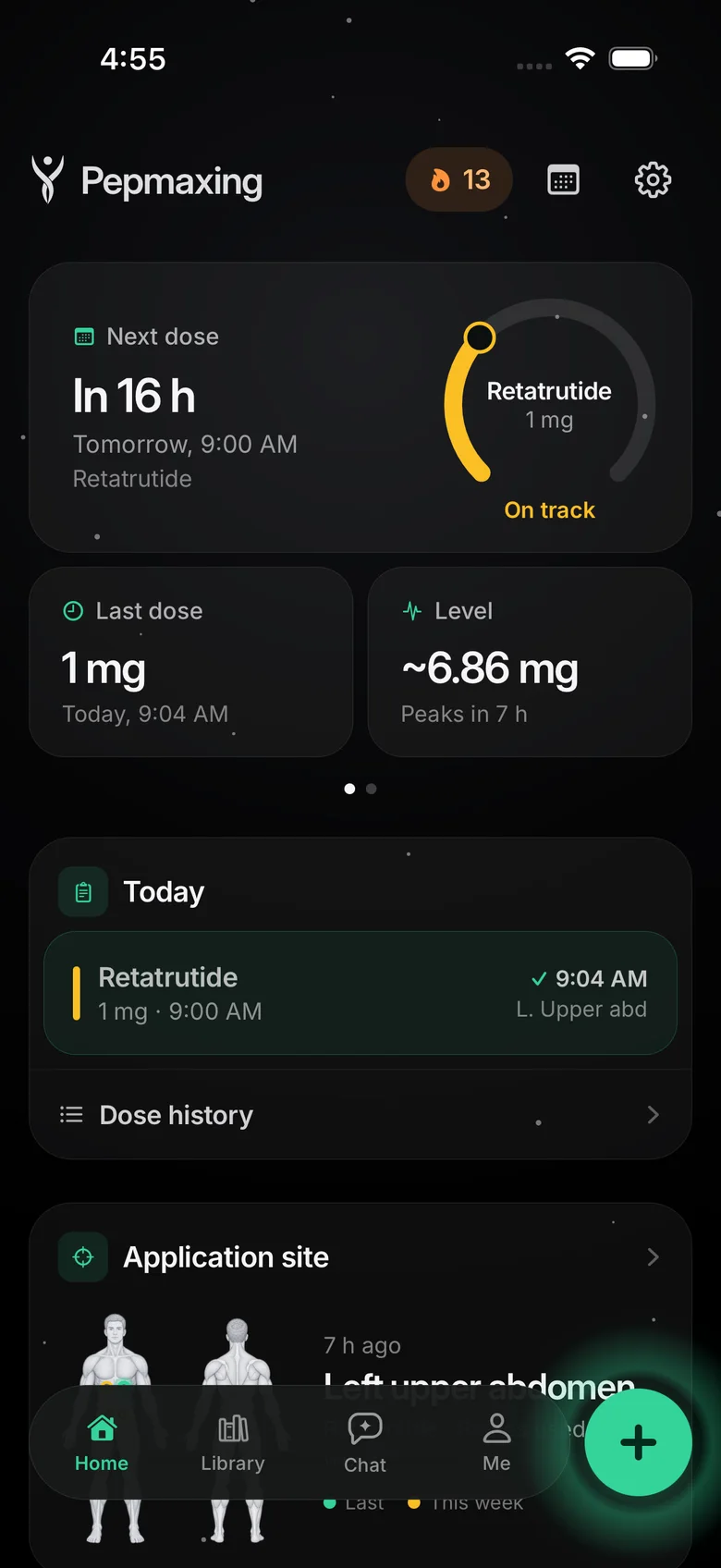
Titrating from 0.5 to 1 mg? Edit the protocol and the change applies from today. Every earlier dose keeps the amount you actually took — your history stays true.
Doses, injection sites, reconstitution, estimated levels, nutrition and progress — in one place that never invents a number.
A little less to think about
Most trackers will happily draw a level curve for a compound nobody has studied. We won’t. Every estimate in Pepmaxing traces back to a published number or to something you logged — and when neither exists, the app says so.
Titrating from 0.5 to 1 mg? Edit the protocol and the change applies from today. Every earlier dose keeps the amount you actually took — your history stays true.
An estimate of how much is in your body right now, from documented half-lives and the doses you logged. When a compound has no published half-life, we say so instead of drawing a pretty line.
Twenty-eight injection points on an anatomical map. See what you used this week and get the next site suggested for you — never the last one, always the least-recently used.
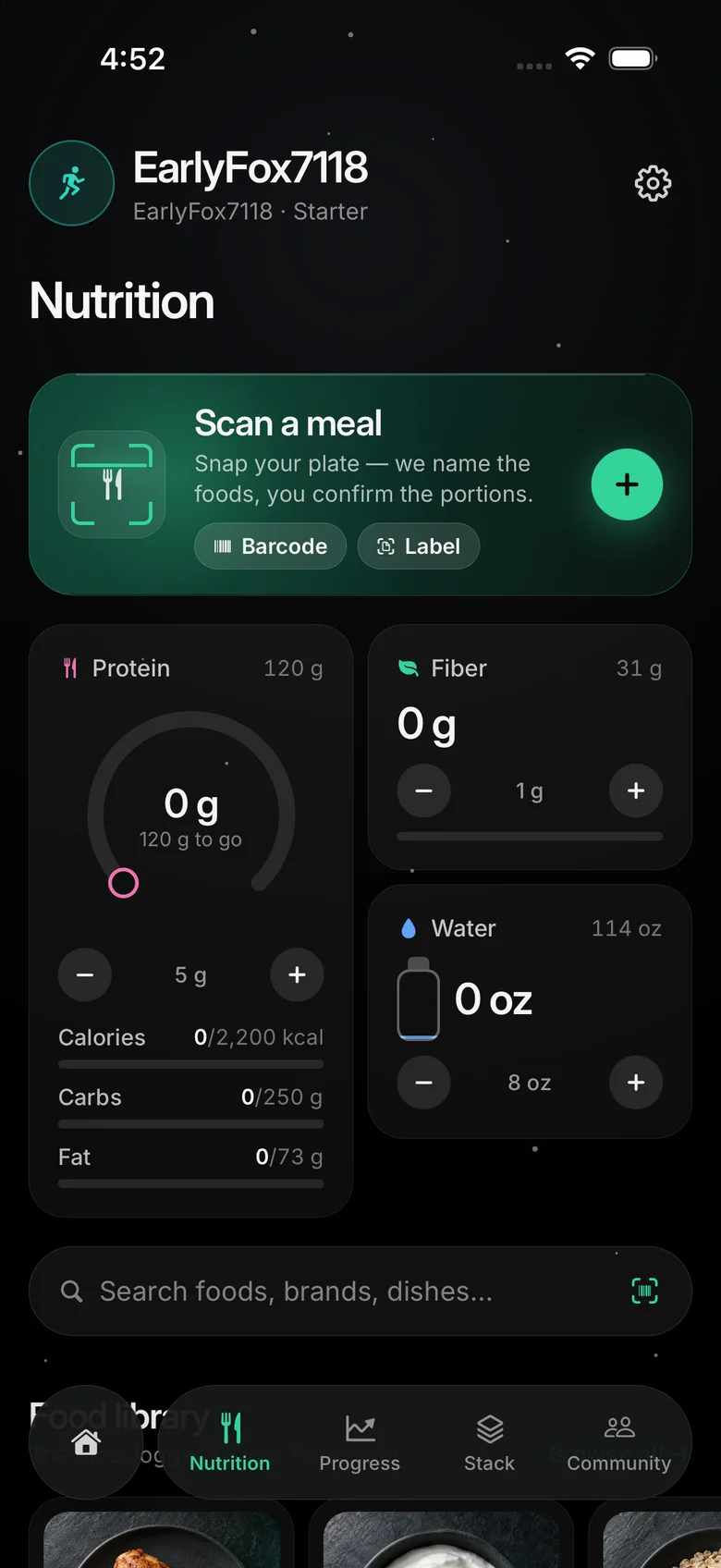
Photograph your plate and we name the foods and estimate portions — you confirm. Scan a barcode for exact label data, or read a Nutrition Facts panel. Thirteen thousand foods from the USDA and Open Food Facts behind it.
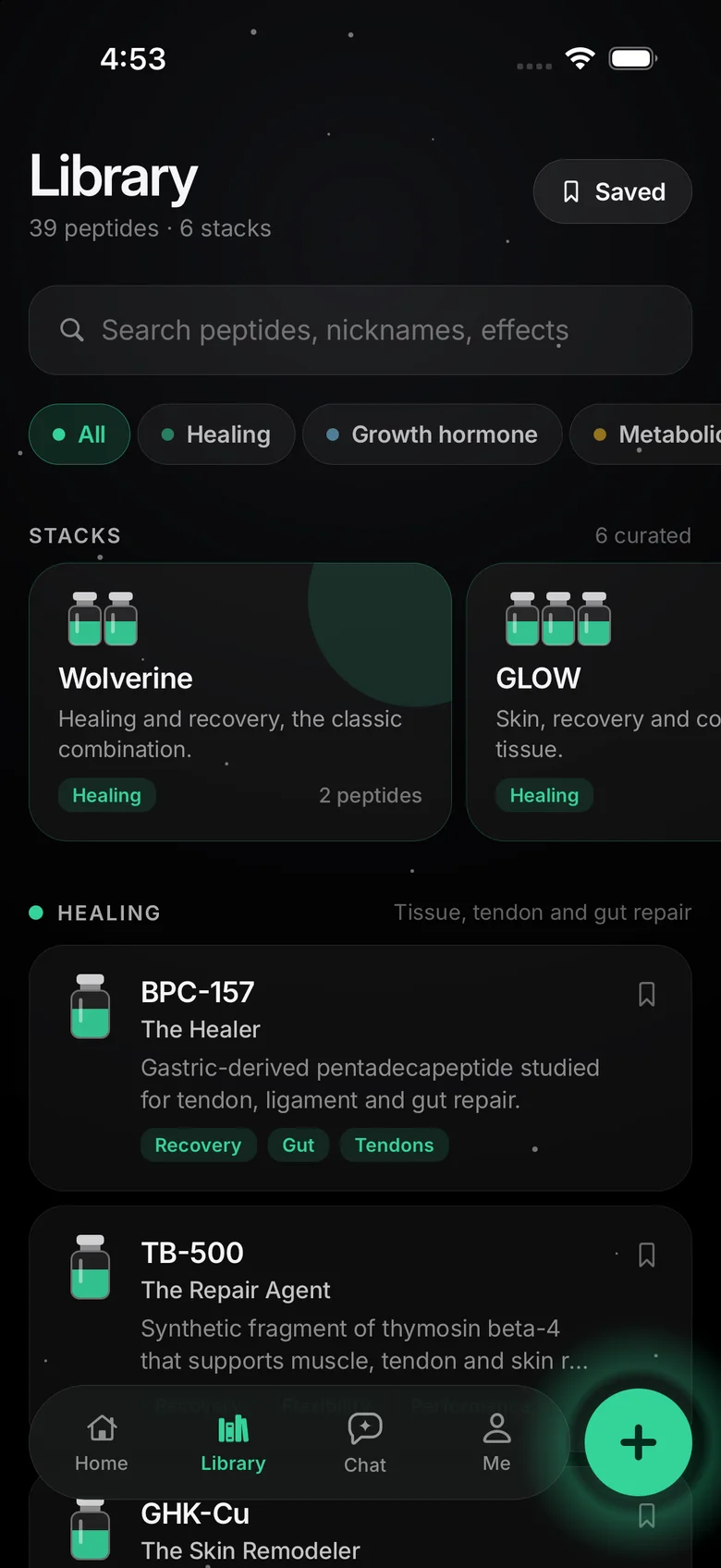
Thirty-nine peptides and six curated stacks, written from the published evidence — animal-only data is labelled as such, and no dose ranges appear without a citation.
One slow turn in front of your iPhone becomes a 3D body that is yours: waist, hips, chest, arms and thighs measured off the fitted model, weight and body fat estimated — every number tagged with how it was obtained, nothing uploaded. Then Ahead morphs your own body to where published trial curves for your dose put the average participant.
Try it: pick a compound, slide the months →One slow turn in front of your iPhone and this human body model is shaped to you — outline, joints and angle read from twenty-four frames, on the phone. Then pick the compound and dose you're on, slide the months, and the app draws your own body where the published trial average lands. Try it here with the model: choose a starting weight, a compound, a dose, and a time.
Drag to turn
Pick a compound to draw the body ahead.
A projection from published trial averages for the average participant at that dose — a range in the app, never a prediction for you, and never a dose recommendation. The body is the model before it has been fitted; the scan shapes it to you.
When a peptide has no published elimination half-life, our Level tile says exactly that — no curve, no “peaks in 10 h”. When a meal photo is an estimate, the sheet says ±25–35% and lets you correct every item. When a piece of research is animal-only, the library labels it.
That honesty is the product. A number you can’t trust isn’t precision, it’s decoration.
The level curve uses prescribing-information and phase-1 values. Nothing else.
Row-level security on every table. Delete everything from Settings in two taps, or request a copy by email.
The assistant does reconstitution maths and reads your trends. It will not tell you what to take.
Meal and label photos are processed once and discarded. Progress photos sit in a private bucket only you can open.
Yes. Everything you log is stored under your own account and protected by row-level security, so no other user — and no one outside your account — can read it. Photos live in a private bucket only you can open. You can delete everything, at any time, from Settings — or ask us for a copy of your data by email.
No. Pepmaxing is a tracking and educational tool. It never recommends a dose, a protocol or a compound. The library summarises published research with sources so you can have better conversations with your clinician — decisions belong with the two of you.
No, and we never will. We do not sell, source or link to any compound. We track what you decide with your clinician.
The photo is sent to an AI model that names the foods and estimates portions; the macros then come from our USDA-based library, and you confirm or adjust each item before anything is logged. Photos are analysed once and never stored. Estimates from a photo are ±25–35% — the app tells you that, too.
Yes. Logging, the calendar, the level curve and the common-foods library all work without a connection. Changes sync to your account when you are back online.
Sign in with the same Apple or Google account and everything — protocols, doses, photos, meals, chats — is restored before you even reach Home.
In the app: Settings → Delete account. Two taps, and your account with all of its data is permanently removed, including photos. There is also a step-by-step guide on this site.
Your protocol. Your progress. Your Pepmaxing.
iPhone first. Android is on the roadmap.